
Meihanda has been manufacturing bicycles and frames in Jiujiang Town, Foshan,
Guangdong since 2000. Most bicycle suppliers show you a catalogue. We are going
to show you the floor.
This page walks through the six production stages a frame passes through at our
Foshan factory — from mould engineering to export packing — and the seven quality
checkpoints it has to clear. If you are sourcing bicycles or frames from China,
this is the process you should be auditing your own supplier against.
You do not have to take any of it on faith. Every stage below is something you can
verify on a video call with the line running.
- 20+ years continuous production, since 2000
- In-house carbon layup & alloy welding
- ISO 4210 structural & fatigue testing
- 100% pre-ship function test
On this page
- Who we are — and who we are not
- Stage 1: Frame engineering & mould development
- Stage 2: Carbon layup & moulding
- Stage 3: Aluminium butting & TIG welding
- Stage 4: Finishing, paint & decals
- Stage 5: Assembly & torque verification
- Stage 6: Packing & export
- Quality control: the 7 checkpoints
- What ISO 4210 actually requires
- Materials we work with
- Certifications & credentials
- Documentation you receive
- Book a factory walkthrough
- Questions buyers ask us
Who We Are — And Who We Are Not
We are not a trading company. We are the factory.
Meihanda has been building bicycles, frames and components from our own production
facility in Jiujiang Town, Nanhai District, Foshan City, Guangdong since
2000. Foshan is one of China’s most established bicycle manufacturing hubs —
which means the tubing mills, the paint suppliers, the component distributors and the
skilled welders are all within an hour of our gate. That proximity is not a marketing
line; it is the reason we can hold a production schedule.
We operate a complete production system under one roof: bicycle design, frame production,
component manufacturing, final assembly and export packing. Nothing critical is
subcontracted to a third party you have never met. When you ask us why a weld looks the
way it does, you are asking the person who welded it.
That distinguishes us from the majority of „bicycle manufacturers“ you will find online.
A trading company can quote you a price, forward your drawings, and mark up the result.
It cannot tell you what went wrong on the mould, because it was not standing at the
mould. It cannot fix a lead-time slip, because it does not control the line. And it
cannot let you walk the floor, because there is no floor to walk.
We publish this page for one reason: a buyer sourcing from China deserves to see the
process before they wire a deposit. Read it, then come and audit us against it.
How a Bike Frame Is Made: The Six Production Stages
The process below is the same whether you order an open-mould platform or a fully
custom frame. What changes is how much engineering happens before Stage 2 — a private
mould adds weeks at Stage 1 and pays it back in production consistency.
Stage 1: Frame Engineering & Mould Development
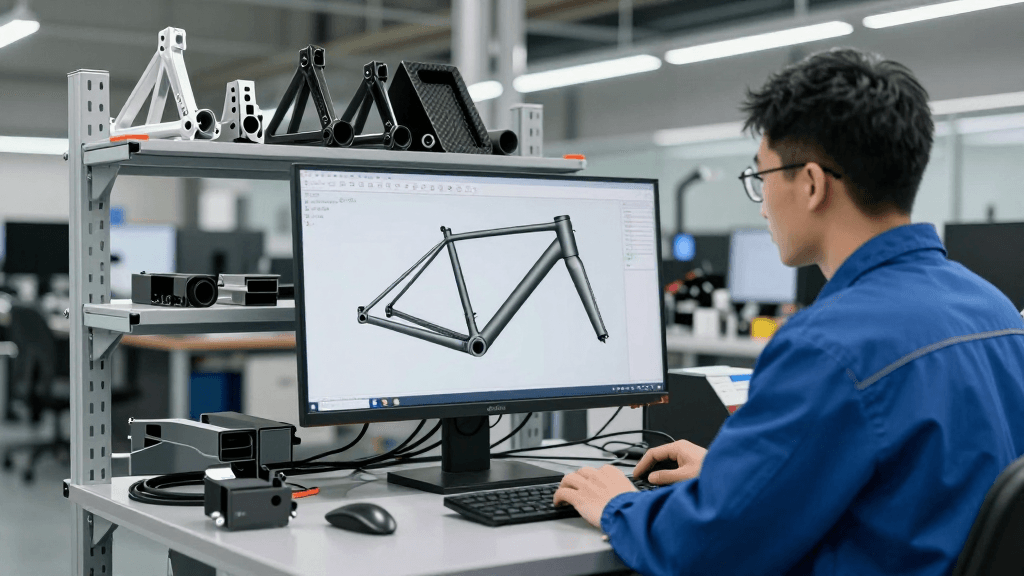
Every model starts as a geometry file. For OEM customers this is your tech pack; for ODM
customers it is our engineering team working from a target ride feel, rider position and
price point. We define stack and reach, head tube angle, chainstay length, tyre clearance
and the layup schedule for each frame size — not just one size stretched across a range.
The layup schedule is the part buyers underestimate. Two frames can use identical T800
carbon and ride completely differently, because what determines stiffness, compliance and
weight is where the plies go, at what angle, and at what thickness.
We specify ply orientation and wall thickness per zone: stiffer through the bottom bracket
and head tube, more compliant in the seat stays and seat tube.
Before a single mould is cut we check the model for mouldability, tool access and
demoulding. A geometry error caught here costs a day. The same error caught after the
mould is cut costs a mould.
Stage 2: Carbon Layup & Moulding
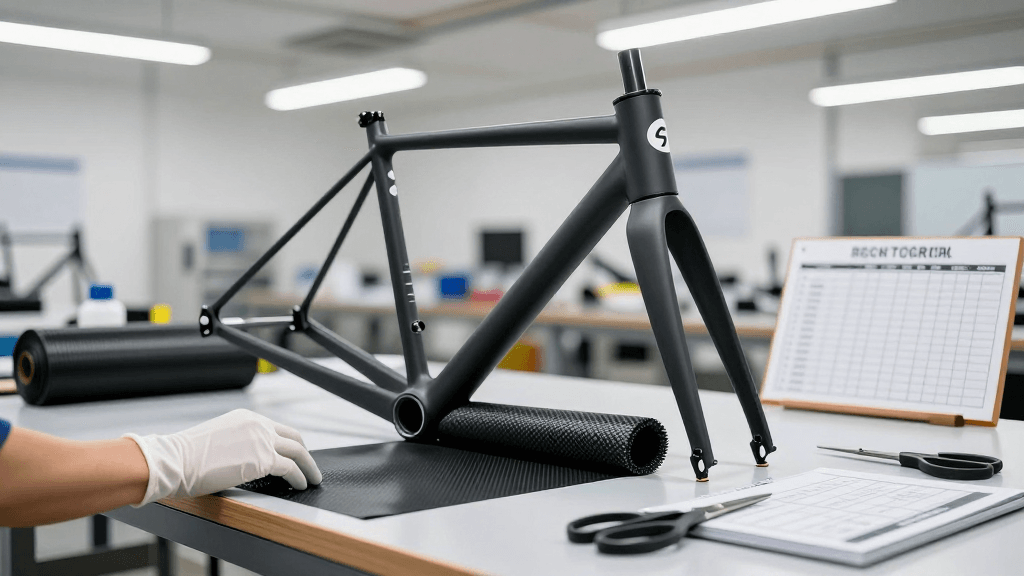
We work with pre-preg carbon in T700, T800 and T1100 grades, laid by hand in
0° / 45° / 90° orientations according to the engineering spec. Hand layup is
slower than automated placement, and for the volumes and variety we run it is also more
accurate — every ply is positioned and consolidated by a person who can see it.
The laid-up frame goes into the mould and is cured under controlled heat and pressure. The
variables that matter at this stage are temperature ramp, dwell time and pressure profile.
Rush the ramp and you trap volatiles; under-pressure the part and you leave voids that will
never show up on a visual inspection but will show up on a fatigue rig.
After demoulding, each frame is checked for wall thickness consistency at the critical
junctions, and for surface voids and resin-rich areas. Frames that fail go into scrap, not
into a „second grade“ bin.
Stage 3: Aluminium Butting & TIG Welding
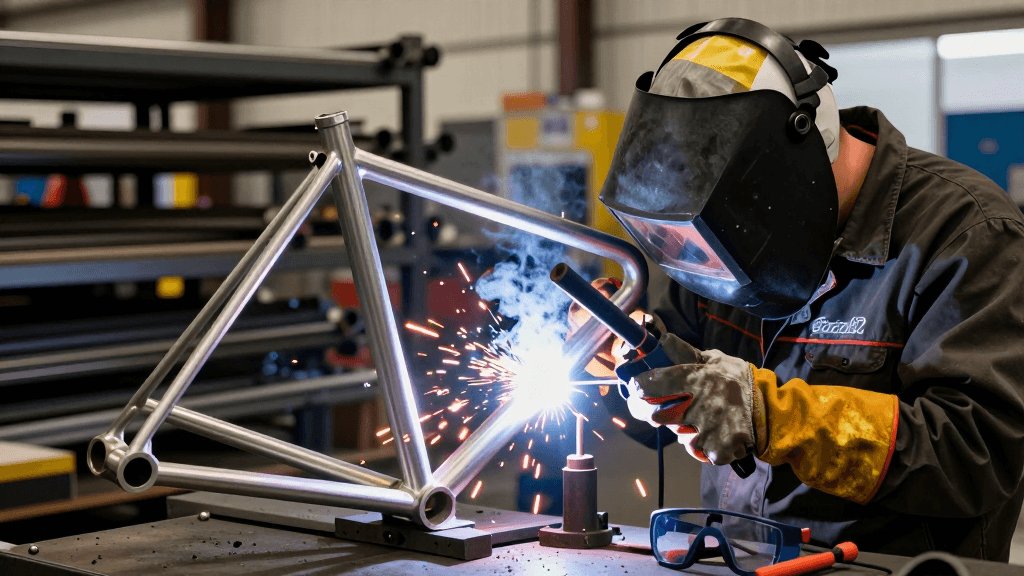
Our aluminium frames use 6061 and 7005 tubing, butted so that
material is removed from low-stress mid-sections and left where the stresses concentrate at
the joints. Butting is how you take weight out of an alloy frame without taking strength out
of it — and it is the reason two „the same“ aluminium frames can differ by hundreds of grams.
Tubes are TIG-welded, then the welds are inspected and the frame is stress-relieved to
release the residual heat-affected-zone stresses that welding introduces. Skip the
stress-relief and the frame may pass its static test in the factory and crack two seasons
later in the field. This is exactly the kind of step a trading company cannot verify on your
behalf.
Stage 4: Finishing, Paint & Decals
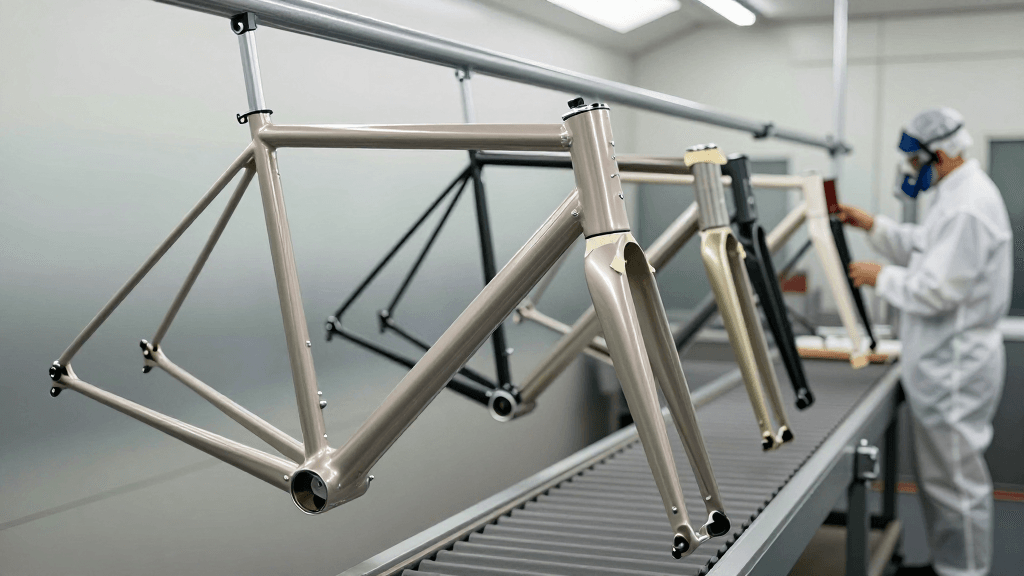
Frames are sanded, primed and painted in a controlled booth, decaled with your brand
artwork, and finished with clear coat. Paint is where a factory’s discipline is most visible
to your end customer: an inconsistent batch is what people notice in a showroom, and paint
adhesion failure is what they complain about after a winter of road salt.
We match your brand colours, and we can supply in gloss, matte or satin across the same
batch. For ODM customers we hold standard colourways so you can re-order without a new paint
development cycle.
Stage 5: Assembly & Torque Verification
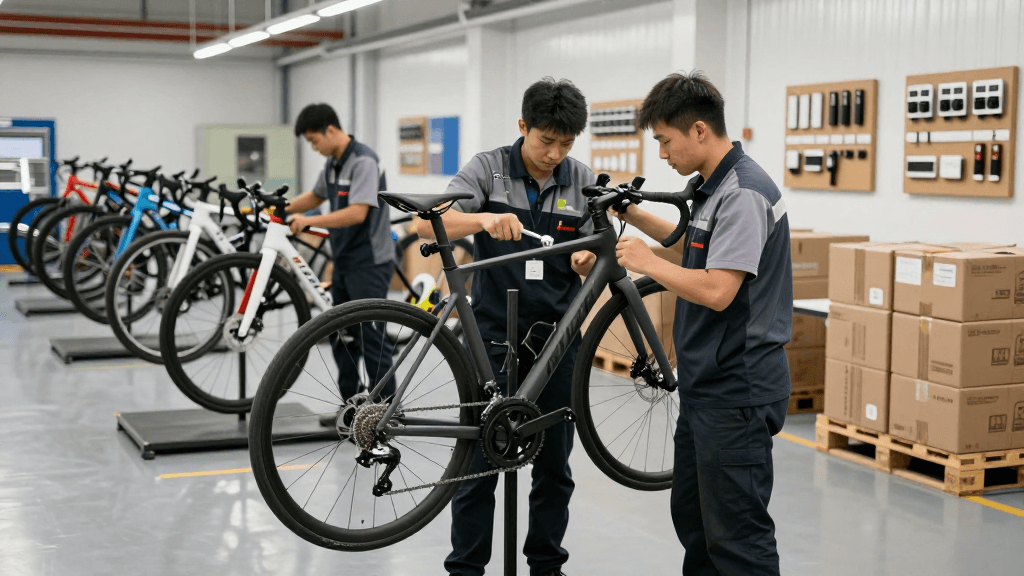
Complete-bike assembly fits the groupset to your specification — Shimano, SRAM
and compatible drivetrains — plus wheels, cockpit, brakes and finishing kit. Frames-only
orders skip this stage but still go through the frame-level checks in the QC table below.
Every fastener is torque-verified against the component manufacturer’s published value, and
the bike is function-tested before packing: shifting indexed through the range, brakes
bedded and checked for rub, wheels trued, bearings checked for play. A bike that leaves our
dock untested becomes your after-sales problem, and then your reputation problem. We would
rather find it here.
Stage 6: Packing & Export
We pack either complete or KD (knocked-down) depending on your
market and your customs situation. KD packing cuts freight volume substantially on
container shipments, and in several markets it also changes the applicable duty treatment —
worth checking with your broker before you specify.
Cartons are rated for drop and vibration in transit, and frames are separated and protected
at the contact points. The last thing a QC process should be is undermined by a box that
fails at the port.
Quality Control in Bike Manufacturing: The 7 Checkpoints
This is the checklist we run on every order. If you are auditing a potential supplier,
ask them which of these seven they perform in-house and which they rely on a sub-supplier
for — the answers are revealing.
| # | Stage | What we check | Standard | What it catches |
|---|---|---|---|---|
| 1 | Incoming material | Fibre grade, tubing alloy, component authenticity | Batch inspection | Substituted fibre or tubing grade — the most common hidden cost cut in the industry |
| 2 | In-process | Ply orientation, weld integrity, mould dimensions | Per lot | Layup drift across a production run, and mould wear that shows up as geometry variation |
| 3 | Frame structural | Static load & fatigue testing on sampled frames | ISO 4210 | Frames that survive the showroom but fail the rider |
| 4 | Finish | Coating thickness, adhesion, colour match | Visual + gauge | Paint that chips at the dropouts, and batch-to-batch colour drift |
| 5 | Assembly | Torque verification on all fasteners | 100% of units | Cracked carbon from over-torquing, and loosening from under-torquing |
| 6 | Function | Shifting, braking, wheel truing, bearing play | 100% pre-ship | The failures your customer finds in the first week |
| 7 | Packing | Drop- and vibration-rated export cartons, KD or complete | Freight-tested | Transit damage caught before it ships to you |
Checkpoints 5 and 6 are applied to 100% of units. Checkpoints 1–4 and 7 are applied per
batch or per lot, with sampling rates set by order size and product type.
What ISO 4210 Actually Requires — And Why It Is Our Baseline, Not Our Target
ISO 4210 is the international safety standard for bicycles. It covers test methods and
requirements for frames and forks — among them static load cases at the head tube, bottom
bracket and seat, and fatigue cycling that simulates years of road input. Passing it is the
minimum bar for selling a bicycle into most regulated markets.
A lot of suppliers present „ISO 4210 compliant“ as a selling point. We want to be precise
about what it means, because it is often used loosely:
Compliant ≠ tested
A factory can build to a design that was once tested and report itself compliant
without testing your batch. We run structural and fatigue testing on sampled frames
from production, and we will send you the results.
Tests are sampled, not universal
Destructive testing breaks the frame, so no factory fatigue-tests every unit. The
meaningful question is what the sampling rate is and who holds the records. Ours are
available with your order.
Standards are a floor
ISO 4210 tells you a frame is not unsafe. It does not tell you the frame is stiff
enough for a sprint, compliant enough for a century ride, or built to hit your
weight target. Those are engineering decisions.
Where your destination market requires additional certification, tell us at the quotation
stage. We can support the testing and documentation that market entry needs — and it is far
cheaper to design for it than to retrofit it.
Materials We Work With
| Material | Grades we use | Where it fits |
|---|---|---|
| Carbon fibre (pre-preg) | T700 / T800 / T1100 | Road, gravel, MTB and e-bike frames and forks; wheelsets, cockpits, seatposts |
| Aluminium | 6061 / 7005 | Volume production frames, e-bike frames, kids‘ bikes, all-mountain builds |
| Steel | Chromoly and selected tube sets | Heritage and touring builds where ride feel and repairability matter more than weight |
| Components | Carbon wheelsets, cockpits, dropper posts | Brand-matched component lines, KD assembly kits |
Material choice should follow your market and price point, not the other way round. If you
are unsure which grade gets you to your target weight and stiffness at your target cost,
send us the target and we will recommend — that conversation costs you nothing and usually
saves a mould.
Certifications & Credentials
Buyers ask two questions about a Chinese supplier: are you actually a factory, and can I check?
Here is what we hold, and how each one is verified.
amfori BSCI social compliance audit
Our facility is audited under the amfori BSCI social compliance system, which covers
labour conditions, working hours, health and safety, and management systems. It is an
audit of how the factory is run, not a product test — which is why we pair it with the
ISO 4210 testing described above.
Own export licence
We hold our own import/export licence, which means we ship to you directly rather than
through a trading agent. Your order, your documents and your shipment are all handled by
the factory that made the goods.
Our own brand: XTREME
We design, build and sell bicycles under our own brand. That means we have sat on your
side of the table — carrying inventory, handling customer claims and hearing what riders
complain about. It changes how we build for brands.
Registered trademark portfolio
Our own brands and model names are covered by registered trademarks. We respect
third-party design rights for the same reason, and we will not reproduce a protected
competitor design on request.
Copies of audit documentation and ISO 4210 test reports are available to buyers on request
under NDA. Ask for them at the quotation stage — a supplier who hesitates to document a claim
is telling you something useful.
Documentation You Receive With Every Order
Trust is easier to extend when the paperwork is there. Alongside the goods, an order
can include:
| Document | What it gives you |
|---|---|
| QC inspection record | What was checked, at which checkpoint, and the outcome |
| Structural & fatigue test results | Evidence behind the ISO 4210 claim for the frames sampled from your order |
| Pre-shipment photo set | Finished units, packaging and carton labelling before the container is sealed |
| Packing list & carton manifest | Accurate counts and dimensions for freight and customs |
| Component specification sheet | The exact BOM shipped, so your after-sales team knows what is on the bike |
Ask for these at the quotation stage and confirm them in the PO. A supplier who resists
documenting the order is telling you something.
How to Verify a Bicycle Factory Before You Order
Everything on this page can be checked. There are three ways to do it, in increasing order
of effort — and we offer all three:
1. Live video walkthrough
A scheduled call with the line running. Ask to see the layup room, the welding bay,
the paint booth and the test rig — in one continuous call, not an edited clip.
2. Sample order
Commission a prototype or pilot batch and hold it physically. You will learn more
from one frame in your hands than from a hundred catalogue pages.
3. On-site visit
We host buyers and brand teams on site in Foshan. Bring your engineer. Walk the
floor, meet the people who will build your product, ask us anything.
Most buyers start with the video call and move to a sample. That sequence has the highest
return per hour spent, and it is the one we recommend if you are comparing several suppliers.
Questions Buyers Ask Us
How is a bike frame made, in simple terms?
The frame is designed as a geometry and layup specification, then produced by one of two
routes. Carbon frames are built from pre-preg carbon plies laid into a mould by hand in
specified directions, then cured under heat and pressure. Aluminium frames are built from
butted tubing TIG-welded at the joints, then stress-relieved. Both routes finish the same
way: paint and decals, assembly, function testing, and export packing.
How are carbon bike frames tested?
Two categories of test matter. Static load tests apply a defined force to the frame at
the head tube, bottom bracket and seat to confirm it does not fail or deform beyond limits.
Fatigue tests cycle a load many thousands of times to simulate years of riding and reveal
weaknesses that a single static push would miss. Both are destructive, so they are run on
sampled frames from a production batch rather than on every unit.
What is ISO 4210, and is it enough?
ISO 4210 is the international standard covering safety requirements and test methods for
bicycles, including frame and fork structural and fatigue testing. It is the recognised
minimum for selling into most markets. It is not sufficient on its own as a quality
specification — it tells you a frame is not unsafe, not that it is stiff, light or
comfortable enough for your product. We treat it as the baseline and specify geometry and
layup to your performance target on top of it.
Can I visit or audit the factory?
Yes. We host live video walkthroughs with the line running, and on-site visits by
appointment in Foshan. Third-party audits are also welcome — tell us the agency and we will
schedule around it. Contact us to arrange a date.
Where exactly is the factory?
Jiujiang Town, Nanhai District, Foshan City, Guangdong Province, China. Foshan is one of
China’s established bicycle manufacturing clusters, which keeps our tubing, paint and
component supply chain local and short.
Do you manufacture in-house or sub-contract?
Frame production, carbon layup, alloy welding, painting, assembly and export packing are
all handled in-house. Components such as groupsets, tyres and saddles are supplied by their
manufacturers, as they are by every bicycle factory. The distinction that matters is that
the frame — the part your brand is judged on — is made by us, in our building, by people you
can meet.
What is the difference between OEM and ODM?
OEM means you bring the design and we build it: your geometry, your layup spec, your
brand. ODM means you build a brand on a platform we have already engineered — you choose
from existing models and customise geometry, components and cosmetics, or commission a new
model from our engineering team. ODM usually reaches market faster; OEM gives you more
product differentiation. We do both, and we will tell you which suits your situation.
How do I know the frame I receive matches the sample I approved?
Three mechanisms: the sample becomes the reference standard held by both parties, in-process
checks cover ply orientation and mould dimensions per lot, and you receive a QC inspection
record plus a pre-shipment photo set before the container is sealed. Any deviation is visible
before goods ship rather than after they arrive.
Want a live factory walkthrough?
We host buyers and brand teams on video calls and on-site visits in Foshan.
Bring your engineer and your questions.


